
The Contemplative Gate and Depth of Makarios: Blessed Beyond Happiness
A personal reflection and prayer by Ian J Mobsby

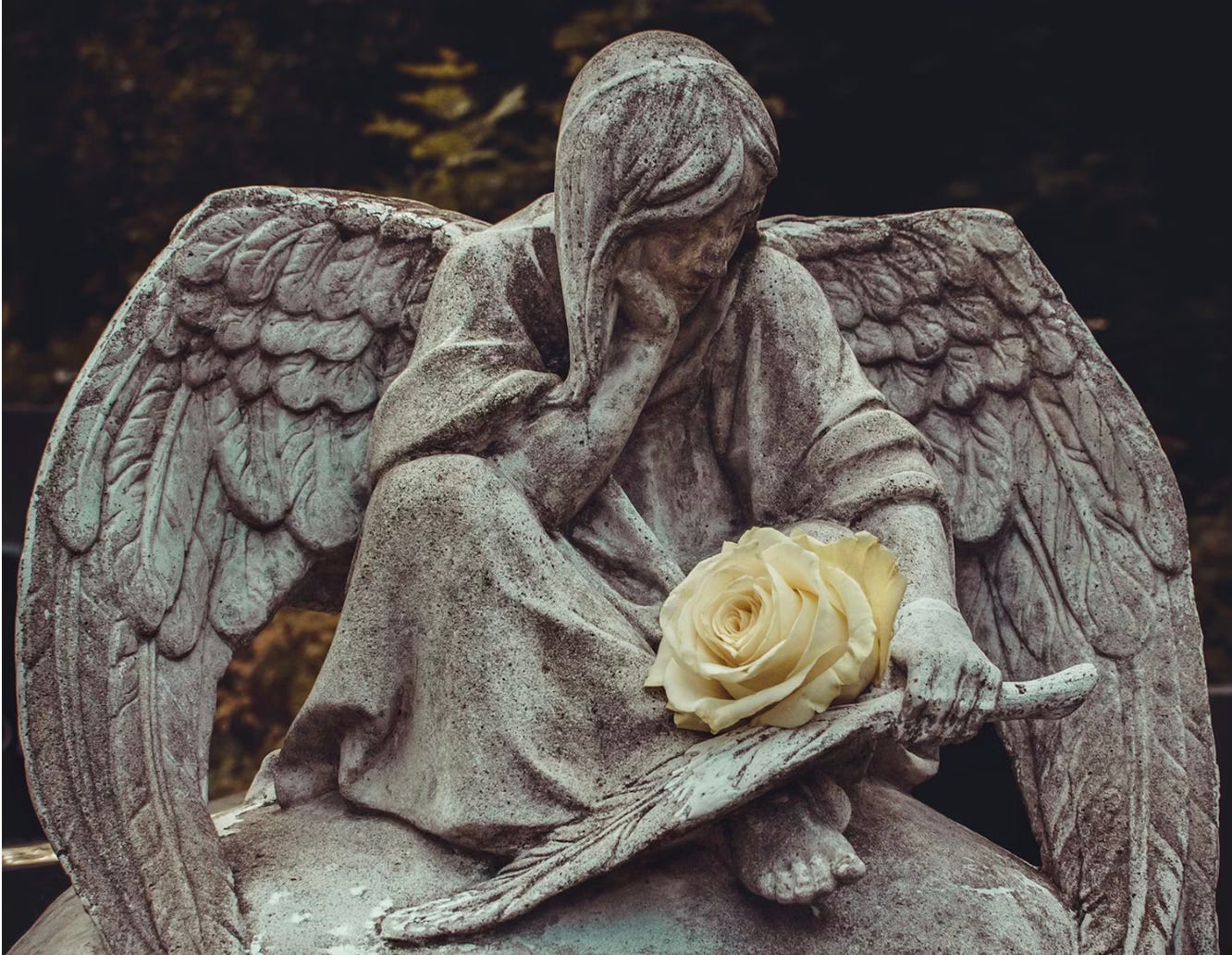
Following comments to my previous post on the Beatitudes, and also that which has been sparked by Charlie, a new Christian theologian friend, and because my life is pretty shit right now if I am going to be honest, I have written this almost as a prayer for me, to get through my current life journey through a dark desert covered in rocks making walking very difficult. So here goes … If you are like me and you try to avoid facing what you are feeling, then this is also for you. Getting below the egoic self is a real challenge particularly when the emotions are intense. .
When Jesus began his public teaching with the Beatitudes, he offered words that have confounded and inspired generations of disciples. “Blessed are the poor in spirit… blessed are the meek… blessed are the peacemakers.” These are not easy sayings. They are not moral slogans or social platitudes, but a profound unveiling of the way of being that flows from divine relationship or union. At the heart of each Beatitude lies a single Greek word—makarios (μακάριος)—a word often translated as “blessed,” and sometimes, less precisely, as “happy.” Yet makarios carries within it a contemplative invitation, one that reveals not only the character of those close to God, but the nature of the contemplative life itself.
In ancient Greek, makarios originally referred to the state of the gods - a life beyond care, untouched by the shifting fortunes of the world. Later, it came to describe the deep contentment of those who live in harmony with divine reality, no longer swayed by external circumstances. The importance of the inner true-self over the egoic outer self. When Jesus used makarios, he was not speaking of mere emotion or circumstantial happiness. He was pointing to a deep interior condition, a state of blessedness rooted in deep relationship with God. For contemplative Christians, makarios describes that inner freedom that emerges when one’s heart is stilled, desires are surrendered, and being itself is at rest in the receiving of divine love.
I just want to make the connection where with Jesus’ teaching of the Shema as the Great Commandment of Jesus which previous Benedictine Roman Catholic Abbot Christopher Jamieson showed me can be understood contemplative as saying “Receive and learn to receive the unconditional love of God, to allow this love to enable you to learn to love yourself and heal (so often I have loathed myself and much of who I am physically) to then from this love to learn and allow this love to help you love others. With this interpretation there is then a deep connection between this teaching and Jesus’s teaching on the Beatitudes.
Thomas Merton saw in the Beatitudes a contemplative manifesto—a radical vision of human transformation through surrender, simplicity, and love. He wrote that the Beatitudes are not commandments to be obeyed, but revelations of what the human heart looks like when it is conformed to the will of God. They are a portrait of the contemplative soul: humble, receptive, merciful, pure in heart, and at peace. For Merton, this “blessedness” was not an external reward for right behaviour, but the inner flowering of divine grace when one lives from the ground of being, rather than from the restless ego.
Seen through the contemplative lens, the Beatitudes are less about achieving something and more about awakening to what already is. The poor in spirit are those who have emptied themselves of self-importance and discovered the spaciousness of God’s presence within. Those who mourn are those who have allowed their hearts to break open, to feel the world’s pain and their own, without turning away. The meek are not weak but inwardly free, no longer driven by fear or pride. Those who hunger and thirst for righteousness are yearning for the truth of divine justice to shape their inner and outer worlds. The merciful, the pure in heart, the peacemakers—all reveal facets of what it means to live from a contemplative consciousness, grounded in compassion and illuminated by love.
Makarios thus names a way of being that arises from the contemplative path. It points to a state of serenity that is not naive or detached from the world’s suffering, but one that sees through it with the eyes of God. It is a blessedness born not of privilege or success, but of surrender. The contemplative life is not a flight from pain but a transfiguration of it. To be makarios is to live in radical trust, even amid uncertainty; to know oneself held in divine mercy, even when the surface of life trembles.
This way of blessedness calls us to live from silence and simplicity, to cultivate interior poverty so that divine fullness may find space within us. In the stillness of contemplation, the meaning of makarios becomes flesh. We begin to sense that blessedness is not something given from outside but a state that awakens when we are present to God in the depths of our being. It is there, in that wordless communion, that the Beatitudes cease to be ideals and become lived reality.
To walk the contemplative path is to live into the makarios vision. It is to accept the paradox that joy can coexist with sorrow, peace can dwell amid chaos, and divine presence can infuse even the most ordinary moments. It is to discover that blessedness is not an escape from the world but a seeing-through of it, a participation in God’s redeeming presence here and now.
Jesus’ use of makarios is therefore not sentimental or abstract. It is the language of divine invitation—a call to become who we truly are in God. Each Beatitude opens a window into the mystery of contemplative transformation, revealing what it looks like when the divine life takes root in human hearts. The makarios person lives from the centre, anchored in divine love, and radiates that love outward into a world starving for mercy and peace.
For contemplative Christians today, to meditate on makarios is to be reminded that the contemplative journey is not about striving but surrender. It is about consenting to the blessedness that already dwells within, the grace that quietly transforms the heart. When Jesus says, “Blessed are you,” he is not describing a distant goal but awakening us to our truest identity—the blessedness of being one with the divine source of all love.
The Beatitudes, then, are not just moral teachings or spiritual aspirations; they are a doorway into contemplation itself. To sit with them in prayer is to let the word makarios echo through the heart, drawing us into the silence where blessedness and being become one. In that silence, the contemplative discovers the same truth that Merton found: that to be blessed is to be awake, to be free, and to rest at last in the love that holds all things.
Prayer Practices Inspired by this Makarios of the Beatitudes of Jesus
Each of these practices leads deeper into the mystery of makarios - blessedness as inner wholeness, freedom, and compassionate awareness. They help form the kind of consciousness that Jesus revealed in the Beatitudes and that contemplatives across centuries have recognized as the heart of divine union.
1. The Prayer of Inner Poverty - Becoming Poor in Spirit
Focus: Letting go of control and resting in divine sufficiency
Begin by sitting quietly and noticing the subtle ways you cling - to thoughts, desires, expectations, or roles. Gently breathe in and say inwardly, “God is enough.”
Breathe out and whisper silently, “I let go.”
Repeat this rhythm for several minutes, letting each breath be an act of surrender. When distractions arise, simply notice them and return to the breath.
This practice leads toward inner poverty, a space where the ego releases its grip and the heart opens to a spacious awareness. You may sense a quiet fullness emerging - not something achieved, but something received. This is the contemplative meaning of makarios: blessedness as inner freedom.
2. The Prayer of Tears - Blessed Are Those Who Mourn
Focus: Allowing the heart to open through compassion
Sit in silence and bring to mind a person, situation, or truth that moves you deeply. Do not analyse or judge it — simply feel. If grief or tenderness arises, allow it to flow freely. The aim is not to fix or explain but to remain present, tender, and open-hearted.
This practice helps integrate pain rather than suppress it. In this spacious awareness, sorrow becomes a gateway to compassion. We begin to experience that blessedness can coexist with suffering - that divine presence holds us in our vulnerability. For those not grounded in religious faith, this practice nurtures deep empathy and human solidarity — the ground of sacred connectedness.
3. The Prayer of Stillness - Blessed Are the Meek
Focus: Cultivating gentleness and trust in the stillness of being
Find a quiet place. Sit comfortably and bring your attention to the breath. With each inhalation, receive life as a gift; with each exhalation, release resistance and striving. If your mind races, imagine yourself as a calm lake - the surface may ripple, but beneath it lies stillness.
In Christian contemplation, meekness is the posture of the soul that rests in God’s quiet power rather than self-will. In secular terms, it’s learning to live from gentleness, not reaction. Through stillness, we awaken to the makarios state - serenity that is not dependent on circumstances.
4. The Prayer of Seeing — Blessed Are the Pure in Heart
Focus: Seeing with the eyes of love
After centring yourself in silence, focus gently on your surroundings. Look slowly at what is before you - a candle, a tree, a face, or even the simple space around you. Let your gaze soften until you are not looking at but through. Whisper inwardly: “Show me how to see as You see.”
This prayer cultivates contemplative perception - the heart’s ability to see God in all things and all people. For the spiritual seeker, it’s a practice of non-judgmental awareness and sacred seeing. The pure in heart are not morally spotless, but inwardly undivided - able to see reality as it truly is, infused with divine light.
5. The Prayer of Peace - Blessed Are the Peacemakers
Focus: Extending inner stillness into the world
After spending time in silent prayer or meditation, place your hand on your heart and say, “Peace begins here.”
Then, imagine that peace radiating outward - first to someone you love, then to someone you struggle with, then to the wider world.
Let this be a prayer of intention, not of control: a gentle release of blessing into the flow of life. When rooted in the contemplative makarios, peace is not an ideal but a natural outpouring of a heart at rest. This practice transforms interior silence into compassionate action.
Photo by Julia Kadel on Unsplash
This post really connected Ian
Thank you
Sorry you are going through a tough time.
We are reading your latest book in our termly online Formation Group. I read it in 2 days, really enjoyed it, listened to a few interviews you've done promoting it (podcasts) recommended these to others and am looking forward to discussing it with fellow LLMs.
It's so timely and thought-provoking and also helpful (personally) and so I have been reading John Main as well - who I had never heard of. I've also gone back to Mark Vernon's book on the Secret History of Christianity, which I had previously read (his new one on Blake is excellent as well) - mainly (sorry about that) because of you quoting him.
Anyway, very grateful for your book and let's hope the ideas in it percolate into a cup running over...
many thanks, Tom