
Easter Week 3: 19-25th April: Reflection: Broken Open, Recognition in Vulnerability and Communion, (Luke 24:28-43)
A Creative 7 Week Adaptation of Stations of the Resurrection by Ian J Mobsby

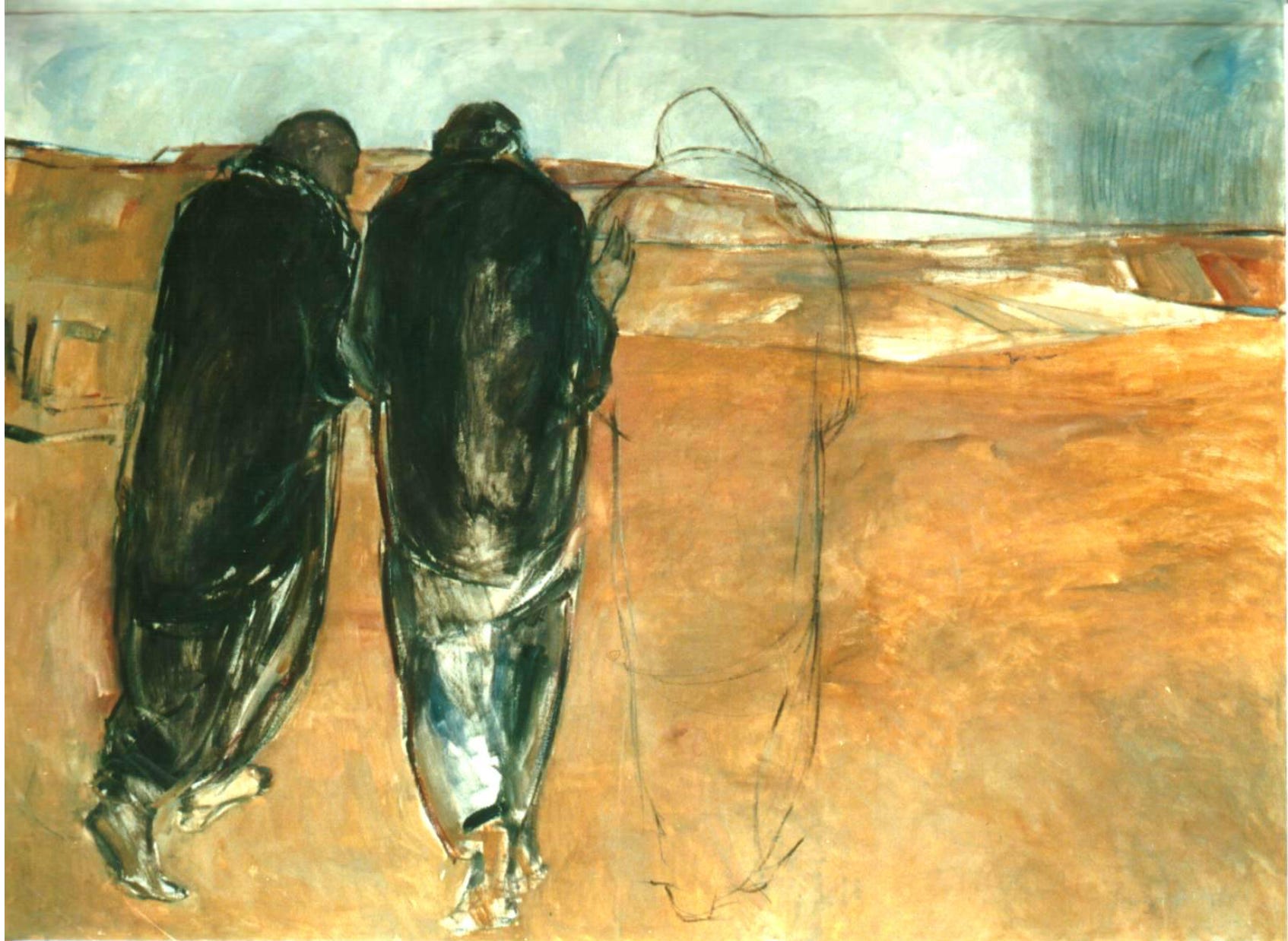
If you have not read the introduction to these 7 reflections and practices for Easter, please see the Intro post about it here.
The reflection for the 1st week of Easter is here
The contemplative practice for the 1st week of Easter is here
The reflection for the 2nd week of Easter is here
The contemplative practice for the 2nd week of Easter is here
Link here for Luke 24:28-43 in the NRSVUE version of the bible.
Reflection for Easter Week 3
Please note there is a contemplative practice audio to go with this weeks reflection here
On the road to Emmaus, everything begins in confusion and grief. The disciples are walking away from Jerusalem, away from hope, from the unbearable collapse of what they thought God was doing. Resurrection, at this point, is not yet a lived reality for them at all. They are not remembering Jesus’ words, probably out of fear, disappointed and fearful that once again their hopes of a Messiah had bee dashed.
And then Jesus comes near and walks with them, although they do not perceive it. Jesus is not immediately recognisable. Instead, it unfolds slowly, almost reluctantly, as if resurrection itself refuses to be grasped too quickly.
Luke tells us: καὶ ἐγγίσας συνεπορεύετο αὐτοῖς — “and drawing near, he went along with them” (Luke 24:15). The verb συνεπορεύετο (he journeyed with them) is striking. It is not a dramatic arrival. It is companionship.
Merton speaks of this as resurrection consciousness: the awakening into the reality that Christ is not simply risen then, but is present now, hidden in the depths of all things, and waiting to be recognised - not by the analytical mind, but by a heart that has been broken open.
This is precisely what unfolds on the road to Emmaus.
At first, the two disciples are locked into what Merton would call the consciousness of the false self: a way of seeing shaped by disappointment, control, and fixed expectations. They had hoped—ἡμεῖς δὲ ἠλπίζομεν—but their hope was tied to a particular outcome, a particular kind of Messiah, a particular narrative of power. And when that collapsed, so did their ability to see.
So Jesus walks with them—but they do not recognise him.
This is the first and necessary revelation: the risen Christ is already present, even when they and we cannot perceive him.
Merton insists that the problem is not the absence of God, but the opacity of our perception. We do not see because we are enclosed within ourselves - within our fears, our projections, our need to make reality conform to our expectations.
And so Luke tells us something subtle but profound: “their eyes were kept from recognising him” - ἐκρατοῦντο οἱ ὀφθαλμοὶ αὐτῶν. There is a kind of holding, a restraint. Not as punishment, but as part of a deeper unfolding. Recognition cannot be forced. It must emerge through transformation.
As they walk, Jesus opens the Scriptures to them. The Greek verb - διήνοιγεν -suggests a gradual, unfolding opening. Their hearts begin to burn - καιομένη ἡ καρδία. Something is happening beneath the surface. Merton would say: the false self is being gently destabilised, and the deeper self, the true self in Christ, is beginning to awaken.
But still, they do not see, because resurrection consciousness does not come through explanation alone. It comes through relational participation.
When they reach the village, Jesus “appears to go further”—προσεποιήσατο πορρώτερον πορεύεσθαι. Again, that holy restraint. Merton writes often of how God respects our freedom, how grace does not violate but invites. Christ does not impose recognition; he creates the space for desire.
For me this is a beautiful illustration, that to encounter God, we need to invite God’s presence through some form of invocation, which is critical in prayer.
The disciples respond by urging him strongly - παρεβιάσαντο αὐτόν - they “compel” or “press” him. There is urgency here, even desperation: Stay with us. The day is nearly over. Darkness is approaching. In their unknowing, they long for presence. And they respond: Stay with us.
There is longing here. A reaching out. Perhaps the first movement beyond the closed world of the false self. They do not yet know who he is - but they know they need him.
And so they sit at table. Here, everything turns.
Jesus takes bread—λαβών
He blesses—εὐλόγησεν
He breaks—κλάσας
He gives—ἐπεδίδου
This fourfold action is not just memory - it is revelation. It is sacramental. It is the pattern of Christ’s life, the pattern of divine love: received, blessed, broken, given.
This echoes the Last Supper, echoing the feeding of the five thousand, echoing the whole Eucharistic life of Jesus. But it is the third verb that holds the key: κλάσας—broken.
And it is in the breaking - κλάσας - that their eyes are opened.
Merton would say: this is the moment where resurrection consciousness breaks through.
Not in control, but in surrender. Not in clarity, but in vulnerability. Not in holding together, but in being broken open.
Because the breaking of the bread is also the breaking of their illusions. The breaking of their expectations. The breaking of the self that needed God to appear in a certain way. And in that breaking, something new becomes possible: διηνοίχθησαν οἱ ὀφθαλμοί—their eyes were opened.
This is not just physical sight. It is contemplative seeing. The kind of seeing Merton describes when he writes of awakening to the hidden wholeness of reality, where everything is suffused with the presence of Christ.
“Then their eyes were opened”—διηνοίχθησαν οἱ ὀφθαλμοί. The passive voice matters. Their eyes are not opened by effort, but by grace. Resurrection is not achieved; it is received. They recognise him. But notice how fleeting this recognition is.
“And he became invisible to them”—ἄφαντος ἐγένετο.
This is crucial. Because resurrection consciousness is not about grasping or possessing Christ. The moment we try to hold onto the experience, it slips away. Not because it is unreal, but because it belongs to a different order of knowing.
Merton calls this the difference between the false self, which grasps and controls, and the true self, which receives and participates.
And what do they recognize? Not simply a familiar face, but a pattern - a way of being. The broken bread reveals the broken Christ, and in that breaking, a new kind of seeing emerges - a way of perceiving reality transfigured by the presence of Christ. It is not that the world changes, but that they and we begin to see it differently: everything becomes charged with the hidden life of God.
The disciples cannot cling to Jesus as an object. Instead, they are drawn into his life as a presence.
And immediately, they begin to reinterpret their experience:
“Were not our hearts burning within us…?”
They realise that Christ was present all along - not just in the breaking of bread, but in the journey, the conversation, the opening of Scripture.
This is the hallmark of resurrection consciousness: retrospective illumination. We begin to see that God was present in places we had not recognised at the time.
And so they return to Jerusalem. Notice the movement: from walking away in despair, to returning in hope. From isolation, to communion. From blindness, to witness. But the story does not end there.
As they speak, Jesus stands among them and he says: “Peace be with you”—Εἰρήνη ὑμῖν.
And again, they are startled. Afraid. They think they are seeing a πνεῦμα - a ghost.
Even after Emmaus, resurrection consciousness is fragile. It is not a permanent state we achieve, but a reality we continually awaken into. So Jesus invites them deeper:
“Touch me and see”—ψηλαφήσατέ με καὶ ἴδετε.
This is extraordinary. The risen Christ offers his body - not as proof in a clinical sense, but as invitation into relationship. Resurrection is not disembodied spirituality; it is deeply, stubbornly incarnational.
Merton insists that true contemplation does not lead us away from the body, from the world, from material reality - but deeper into it, where Christ is encountered.
And then Jesus eats with them. Broiled fish. Ordinary. Physical. Real. This is not a vision detached from life. This is life transfigured.
Merton writes that resurrection is the revelation that all reality is already penetrated by the life of Christ. But we do not see it because we are divided within ourselves. We live at the surface. We remain defended, closed, identified with the false self.
The road to Emmaus shows us another way, where seeing is awakened snd the path of resurrection transformation begins.
The disciples move from blindness to sight, from despair to hope, from isolation to communion. But the turning point is this: they are broken open.
Their expectations are shattered. Their certainty collapses. Their grief is exposed. And in that vulnerable, unguarded space—Christ is recognised.
And so it is with us also. That by consenting to the presence of Jesus in our lives and prayers, we are gradually broken open.
Broken open by disappointment.
Broken open by grief.
Broken open by the failure of our expectations.
Broken open by encounters we do not control.
[notice please the connection again with the Beatitudes].
And in that breaking, something is revealed:
Christ, already present.
Christ, already walking with us.
Christ, already giving himself in the ordinary.
This is why vulnerability is not a weakness in the spiritual life - it is the very place of recognition.
Because the false self depends on control, certainty, and self-protection. But resurrection consciousness emerges when these begin to fall away.
When we no longer need God to meet us on our terms.
When we begin to see that communion - not control - is the heart of reality.
In a world that often feels fractured, anxious, and overwhelmed, this matters deeply. Because resurrection is not an escape from reality - it is the transformation of how we inhabit it.
In the breaking of bread, the disciples do not just recognise Jesus - they are drawn into his way of being. They begin to participate in the life of self-giving love.
This is the deeper transformation.
Resurrection is not just about seeing differently—it is about becoming different.
Becoming people who live eucharistically: receiving life as gift, allowing it to be blessed, accepting the breaking, and giving ourselves away in love.
Becoming people who can recognise Christ not only in moments of clarity, but in the hidden, the ordinary, the vulnerable.
Becoming people who no longer live from the anxious, grasping false self, but from the spacious, receptive, Christ-filled true self.
Merton would say that this is the great liberation.
Not an escape from the world, but a freedom within it.
A freedom to see that even in the midst of suffering, even in the midst of uncertainty, even in the midst of our own brokenness—Christ is present.
And so the Emmaus story becomes our story.
We too walk roads of confusion.
We too fail to recognize Christ beside us.
We too cling to expectations that must be broken.
We too are invited into moments of communion where our eyes might be opened.
And we too are sent back - into the world, into community, into the ordinary - carrying within us this fragile, luminous awareness:
That resurrection is not somewhere else.
It is here. Hidden. Waiting to be recognised.
If only we are willing to be broken open.
And so we pray for the grace to notice.
To notice the Christ who “appears to go further,” yet waits to be invited.
To notice the Christ who is revealed in broken bread.
To notice the Christ who meets us in fear and offers peace.
To notice the Christ who is present in the ordinary, the vulnerable, the shared.
This is resurrection consciousness.
This is the journey to Emmaus.
This is the slow, holy work of being broken open—
until we can finally see.
Group Questions
1. Broken Open
On the road to Emmaus, recognition comes in the breaking of the bread, not before.
Where in your own life have you experienced being “broken open” - through disappointment, grief, or unmet expectations - and how might Christ have been present there, even if you did not recognise it at the time?
2. Recognition and the False Self
The disciples walk with Jesus but cannot see him, their perception shaped by their assumptions and hopes.
In what ways might your own expectations, fears, or need for control make it difficult to recognise the presence of the risen Christ in your life right now?
3. Invitation and Presence
Jesus “appears to go further” and waits to be invited: “Stay with us.”
What might it mean for you, in this season of your life, to consciously invite Christ to “stay” - especially in places of uncertainty, loneliness, or transition?
4. Communion and Transformation
Recognition happens in shared table fellowship, and the disciples are sent back into community with new awareness.
How might practices of shared life - hospitality, eating together, prayer, or conversation - become places where you encounter Christ and grow into what Thomas Merton calls resurrection consciousness?
The Recorded Audio and Words for the 3rd Week Contemplative practice follows this post.
Thanks. I was preaching on this on Sunday. I'd mostly written it by the time I read this, but it was helpful to read and to think about and helped me tease out a few of the points I was trying to make and you did better.